Verify explicitly
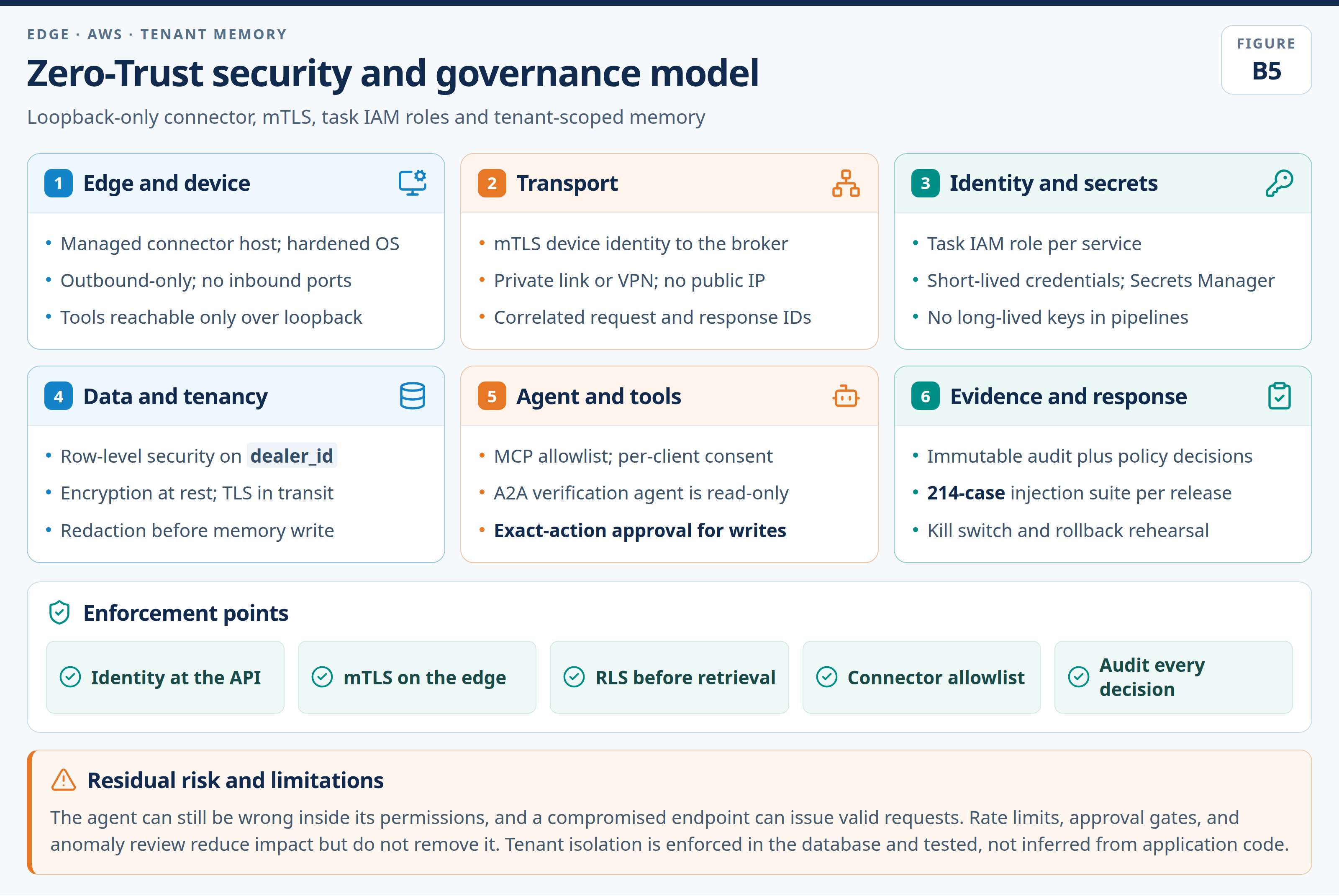
Validate caller identity at the API and device identity through mTLS; evaluate device state and resource permissions before granting access.
Security & governance model
Verify who and what is requesting access, authorize only the required resources, and preserve evidence across an agent’s actions and memory.
No implicit trust comes from network location or device ownership. Authenticate and authorize both the subject and device before establishing a resource session.
Validate caller identity at the API and device identity through mTLS; evaluate device state and resource permissions before granting access.
Limit service roles, connector tools and tenant data to the required scope, with per-client consent and exact-action approval for writes.
Contain misuse with tenant isolation and bounded tool authority; review immutable decision evidence and rehearse the kill switch and rollback.
Standards reference: NIST SP 800-207 — Zero Trust Architecture
01 / Control architecture
Select a domain to explore its controls and where they are enforced.
Identity, action and evidence
across three architectural zones.
Device & connection boundary
Identity & action boundary
Tenant & evidence boundary
Try a broader term, clear the search, or use Reset to return to all six domains.
Explore controls by boundary: dealer edge, AWS application and governed memory.
02 / Enforcement
Where identity, tenant scope and tool permissions become explicit policy decisions.
03 / Residual risk
Authorized does not mean correct. Approval gates and review still matter.
Valid identity alone does not establish the intent of a request.
It cannot be inferred from application code.
Rate limits, approval gates, and anomaly review reduce impact rather than eliminate it.